Ensemble theatre company Idle Motion: Shooting with Light

Our biggest surprise in our recent London theatre binge was a production by an ensemble company called Idle Motion, at a small space called the New Diorama Theatre near Euston Station. The play was Shooting with Light, "devised, written and directed collaboratively by Grace, Sophie, Nathan, Ellie, Juian and Kate" (to quote the program). The company uses dance, theatrical movement and multimedia to tell its stories, and this of course appeals to us. So on a whim, we decided to forego the musical Made in Dagenham (which sounded interesting, but nothing we hadn't seen before under other names), and seek out something that just might be more surprising. We were quite knocked out. We had hoped for good enough, and got something pretty close to marvellous. The story was compelling, the dance/movement was skillful, the acting was honest and unselfconscious, and the inventiveness just kept happening.

Based on Jane Rogoyzka's book Gerda Taro, Shooting with Light tells the true story of a young woman living in Paris in the 1930s. She hooks up with a disheveled young photojournalist who can't seem to sell any photos, smartens him up and starts to manage his career; in return, he gives her a camera and teaches her how to use it. They decide to invent a fictitious American photographer, always out of town, called Robert Capa, and the photos start selling. She changes her name to Gerda Taro, and starts to sell her photos, sometimes as Robert Capa and sometimes under her own name. They both go to Spain to cover the Spanish Civil War, where Robert Capa shoots the iconic photo of a Republican soldier in the moment of being shot. Gerda takes more and more risks, and insists on returning to Madrid after the fall of the city. She is killed at the age of 26 by an out-of-control tank. Treated as a martyr to the Republican cause, she has a couple of years of posthumous fame, and then is largely forgotten, her work subsumed into that of Robert Capa and remembered primarily as Robert Capa's girlfriend.
One reason for this seeming neglect was that most of her negatives, along with many of Capa's photos of the Spanish Civil War, had been stored in a box that was smuggled to the Mexican embassy and forgotten. Robert's photographer brother, Cornell Capa (he changed his name as well) devoted years to tracking down this so-called "Mexican suitcase".
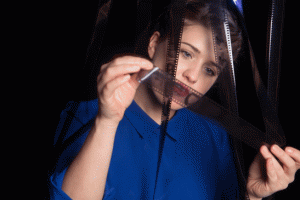
The play opens with Cornell and his assistant June examining rolls of negatives from a compartmented tray. The set is an enlarged version of this tray. They find a roll that contains what they are looking for, and suddenly Gerda (the actor) bursts through the corresponding compartment in the set. It's a wonderful shock, that sets us up for the transformations to come, through the use of projections and physical rearrangements.
Dance and movement are used to break through the convention of naturalism and propel the story onward. The script alternates between the search for the negatives and the truth about Gerda Taro, and the relationship between the two photographers, as they participate in the invention of the craft of photojournalism. This is a story worth telling, in this age of embedded journalists and manipulated media.