
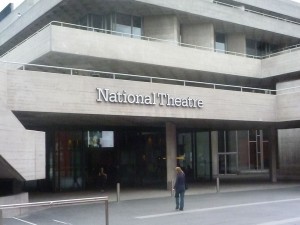
"The Beaux' Stratagem" at the National Theatre

"The Beaux' Stratagem" is usually thought of as a late example of Restoration Comedy, and that's how I was thinking of it as we entered the Olivier. I didn't know the play, but I was ready for a saucy, boisterous romp. It took a little while before I adjusted to its more sedate rhythm and more polite treatment of sexual relations. It was, after all, written in 1707, at the cusp of the Restoration style and the more sedate (and forgettable) sentimental comedy of the 18th century.
At the interval, I said to Judith "I'm not sure what I'm seeing". This, by the way, is not a bad thing. I love being made to stretch.
By the second act, the adjustment was made. I understood that the humour was not that of smart repartee so much as situation. And there are situations a-plenty in this complex, sprawling script, written in haste weeks before the author's death. And where earlier Restoration Comedies challenged morality with lewd double-entendres and farce, the challenge to convention in George Farquhar's play goes deeper: an exposure of the deadening consequences of bad marriages and an argument in favour of the right of a woman to divorce an abusive and neglectful husband.
Two young gentlemen, who have squandered their fortunes, flee London and concoct the stratagem of courting wealthy women in order to obtain their money. They stop at an inn and set their sights on Dorinda and her sister-in-law, Mrs. Sullen, married to a drunken sot. It is these two female characters who are the centre of the play, not their would-be seducers (who are really sheep in wolves' clothing). There are three other strong women's roles: Cherry, the daughter of a corrupt innkeeper; Lady Bountiful, famous for her home remedies; and the servant Gypsy. Instead of being objects of lust and ridicule, these female characters are at the core of the proceedings. It is the men who are shown to be ridiculous.
The director Simon Godwin worked closely with playwright Patrick Marber to adapt the sprawling four-hour original to a more spritely 2 1/2 hours. He faced another challenge in the giant Olivier stage. An elaborate multi-level set of stairways, landings and doorways does double duty as both an inn and the seat of the Sullen household. This contrivance means that we don't have to watch the revolve turning back and forth. The actors perform with spirit, and with great command of a difficult verbal idiom. The music is English country played by an American-style band, including a banjo, musicians always in view and popping now and then onto the stage.
A most interesting play for our second night in London.